
Grat remover for turning chisels by Veritas
Traditionally, bowl scrapers are used as they come from the grinding wheel. The burr that is created during grinding forms the cutting edge. The problem is that such a burr is frayed and unstable, requiring frequent regrinding to renew the "sharp edge." It is not only that such a tool wears out quickly - furthermore, the machined surface is not clean enough and requires a lot of sandpaper use.
The Veritas burr puller for bowl scrapers solves this problem. This burr puller shapes a sharp and even burr. A bowl scraper worked with it is easy to control, produces a very clean surface, and lasts significantly longer. It is also the only one that can pull burrs on HSS tools.

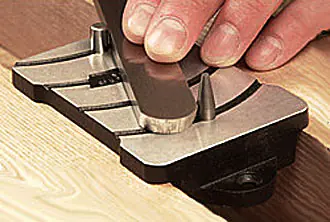
Preparation:
Deburr the edge:
- 2 each 25 mm long carbide pins are included. One is ground to a 10° taper for turning scrapers with a bevel of 70° to 75°, the other to a 5° taper for bevels of 75° to 80°. Choose the suitable one for your scraper.
- First, you grind the mirror side (that is the side over which the existing burr protrudes) on a fine sharpening stone (the stone must be flat) to remove the existing old burr or any that may have formed during grinding.

Turning:
The burr tool should either be clamped - in a vise or on a workbench - or securely screwed onto a tabletop. Choose the one of the two conical carbide pins that best fits the angle of your scraper and insert it into the hole in the center of the upper arch. The round steel pin in the center of the lower arch serves as a guide. Place the scraper with the mirror side facing up on the burr tool plate. With one hand, press the scraper against the burr tool surface, while holding the handle with the other. Bring the edge against the conical surface of the carbide pin and pull the edge along the pin with proper pressure. Use the handle as a lever and the round steel guide pin as a pivot point. Ensure a proper pressing pressure. This is necessary to create the burr, especially on the very hard HSS irons.
Strong pressure creates a coarse burr for greater material removal. Lighter pressure creates a fine burr for less material removal - suitable for fine work.
The carbide pins and the guide pin sit loosely in the holes. These 3 holes allow you to use different distances between the pivot point and the carbide pin (burr tool), depending on the shape and size of your tool. We recommend starting with the default setting as described above.
Note: If you do not intend to change the distance between the pivot point and the carbide pin (burr tool), you should secure the pins with a drop of glue or other suitable material to prevent them from falling out and getting lost.
