
January 24, 2025
Additional information
The use of the Ellsworth "Signature" tube
Made by Crown Hand Tools Ltd, Sheffield, England.
Translated from German to English by our customer Jürgen H.
The unique cutting shape of this tool allows the turner to make both coarse and fine cuts on the outside and inside of a bowl. In most cases, it will remain the only tool needed until the work is completed.
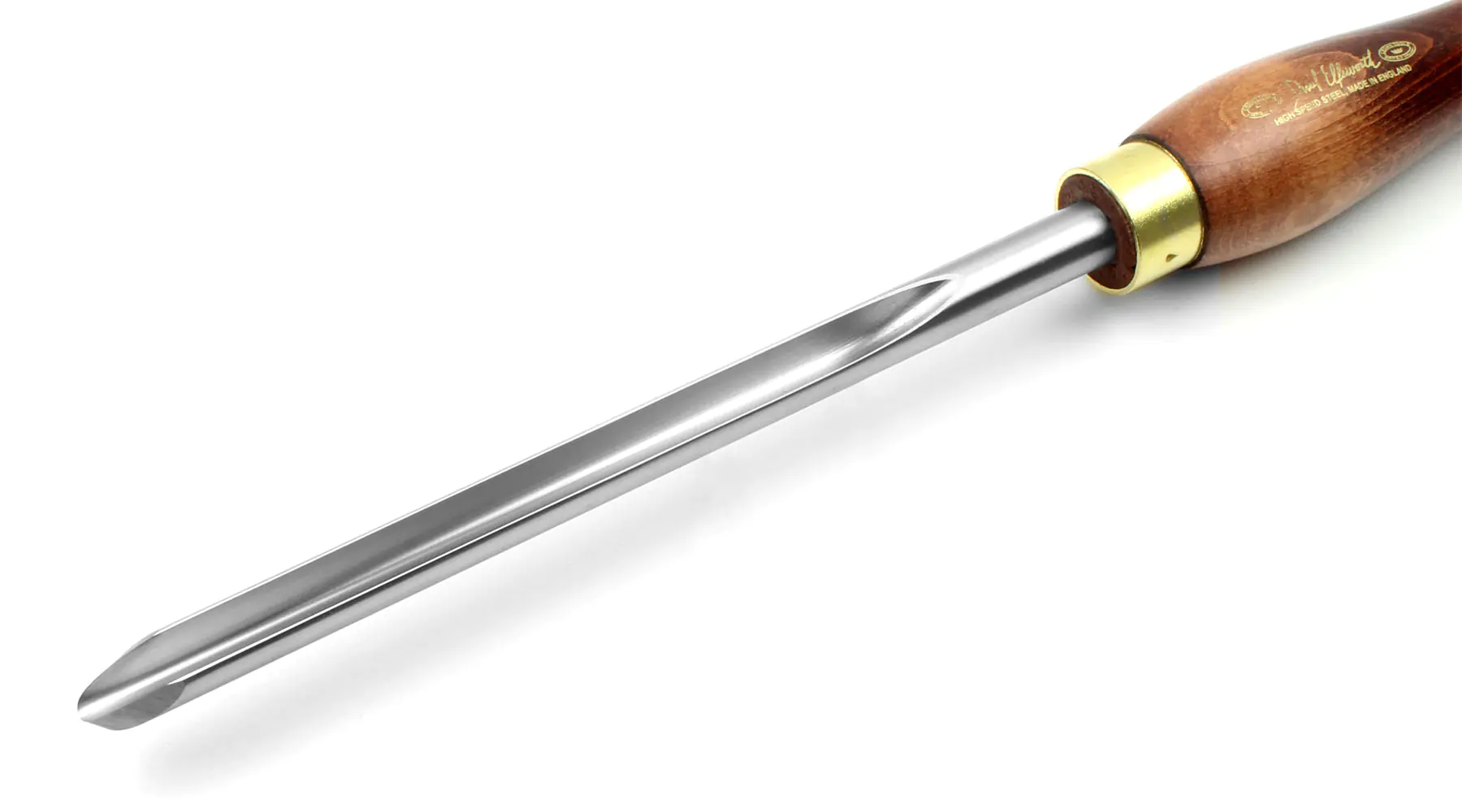
Rough shaping of the outside: quickly removes a huge amount of material when shaping the bowl.
Scroll saw blade
Smoothing the outside: smooths the surface before sanding
- Align the tool rest so that the tube tip points to the workpiece center when the tube is held horizontally.
- Use the tube in a horizontal position, not raised like conventional shaping tubes.
- Rotate the tube in the cutting direction and cut tangential to the grain, not into it.
- Start the cuts only with the tip of the tool (not with the long edge) and keep the cutting side perpendicular to the wood surface, like a scraper. Then rotate the tool axially so that the edge lifts into the wood and begins to cut like a tube. For coarser cuts, a larger part of the long edge is used. Unlike conventional tubes, there is no contact of the bevel with the wood in these coarse cuts.
Rough shaping of the inside: removes the material from the interior of the bowl
- Position the tool rest as above and a maximum of 6 mm away from the workpiece.
- Hold the tool horizontally, as if you want to scrape with the lower edge. The upper edge should not be more than 3 mm away from the material surface.
- Before the edge touches the wood, lower the handle so that the tip of the tube is at a 45° angle to the workpiece. Cut with the lower edge and keep the upper (unused) edge 3 mm away from the wood surface. The bevel should not contact the material.
- Move the tube slowly and lightly cutting over the wood surface. Use the middle area of the long edge, not the tip. Unlike conventional tubes that require the pressure of the bevel against the wood, this tube directs the pressure down onto the tool rest.
- If the tube stutters:
A) Sharpen the tube
B) Reduce the tool feed
C) Increase the pressure on the tool rest
D) Make very light cuts - Advantage! You can finish in both directions, that is, with and against the grain. With most woods, you can now start sanding with grit 180 - 220.
Smoothing the inside: allows a continuous cut from the edge to the bottom of the bowl.
- The type and direction of this cut is exactly like with conventional tubes, starting in the middle and gradually working towards the edge.
- Align the tool rest so that the tube tip points to the workpiece center when the tube is held horizontally.
- The tube should be held horizontally throughout the entire cut. The right side is used for cuts to the right. Again, the bevel does not touch the wood.
- Place one hand on the tool rest as a pivot point, the other on the tool handle as a lever. Rotate the tube clockwise on the pivot point and cut the wood with the right side of the tip.
General notes on sharpening and handling the tool:
- Align the tool rest so that the tip of the tube points to the center of the workpiece when the tube is held horizontally. The tube remains in a horizontal position throughout the entire cut.
- Use the right side of the tip for the initial cut, just like with the rough cut. Cut into the material from the edge by 6 - 9 mm, then rotate the tube (axially) counterclockwise until the inside of the tube is facing directly upwards. This positions the bevel on the left side against the wood.
- Bring the left bevel of the tip into the cutting direction and push the tool forward, making very light cuts of 1.5 mm or less. The cutting area includes the tip itself and no more than 3 mm of the edge to the left of the tip.
- Holding the tube horizontally with the inside facing up, you can now let the bevel glide down to the bottom (towards the center of the bowl) without touching the bed of the lathe with the tool handle.
- Please note, when making the final cut, do not turn the tube to the left, as this will engage the full length of the 19 mm cutting edge into the bowl wall.........Ouch!