February 10, 2025
Interesting facts
Japanese combination mini sharpening stone grit 250/800
Japanese sharpening stones should only be used with water, never with oil! It is best to soak it in water for 5 minutes before sharpening. It should not be stored permanently underwater.
Also very well suited for axes and sickles! Keep in mind when deciding on this stone that it cannot ultimately replace a large stone. You will need longer for sharpening in any case. This stone is not suitable for tools that require high precision of the grind, such as plane irons or chisels.
Also very well suited for axes and sickles! Keep in mind when deciding on this stone that it cannot ultimately replace a large stone. You will need longer for sharpening in any case. This stone is not suitable for tools that require high precision of the grind, such as plane irons or chisels.

Purpose
FZ:
Suitable for longitudinal cutting with large cutting depths in soft and hardwood.
Suitable for longitudinal cutting with large cutting depths in soft and hardwood.
Features
- Various knives for the kitchen, small knives, craft knives, carving knives, sickles, cutting tools for gardening.
- Very well suited for anyone who doesn't actually deal with grinding and still wants to achieve an acceptable result.
- Practical for on-the-go due to its size.
Handling
- Safety - The safety stopper between the grinding stone and the handle ensures that the knife and hand do not come into contact during the grinding process.
- Practical double-sided combination stone - Only one grinding stone is sufficient for coarse grinding (green side) and fine grinding (reddish-brown side).
- Versatility - Regardless of whether the blade is thin or thick, you can sharpen stainless steel knives, forged knives, and other commercial knives.
Handling options
- Before use, soak the sharpening stone well with water.
- First grind on the green side, then finish grinding on the reddish-brown side.
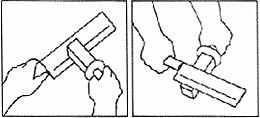
- Sharpening for knives: Depending on the type of knife, different methods can be used for sharpening, see the illustrations below for handling.
- After use, wash the sharpening stone under running water and store it dry and frost-free.